Technique & Science
How to Shape a Boule and a Batard
Step-by-step guide to shaping a boule (round) and batard (oval) loaf, covering pre-shaping, bench rest, surface tension, and seam placement.
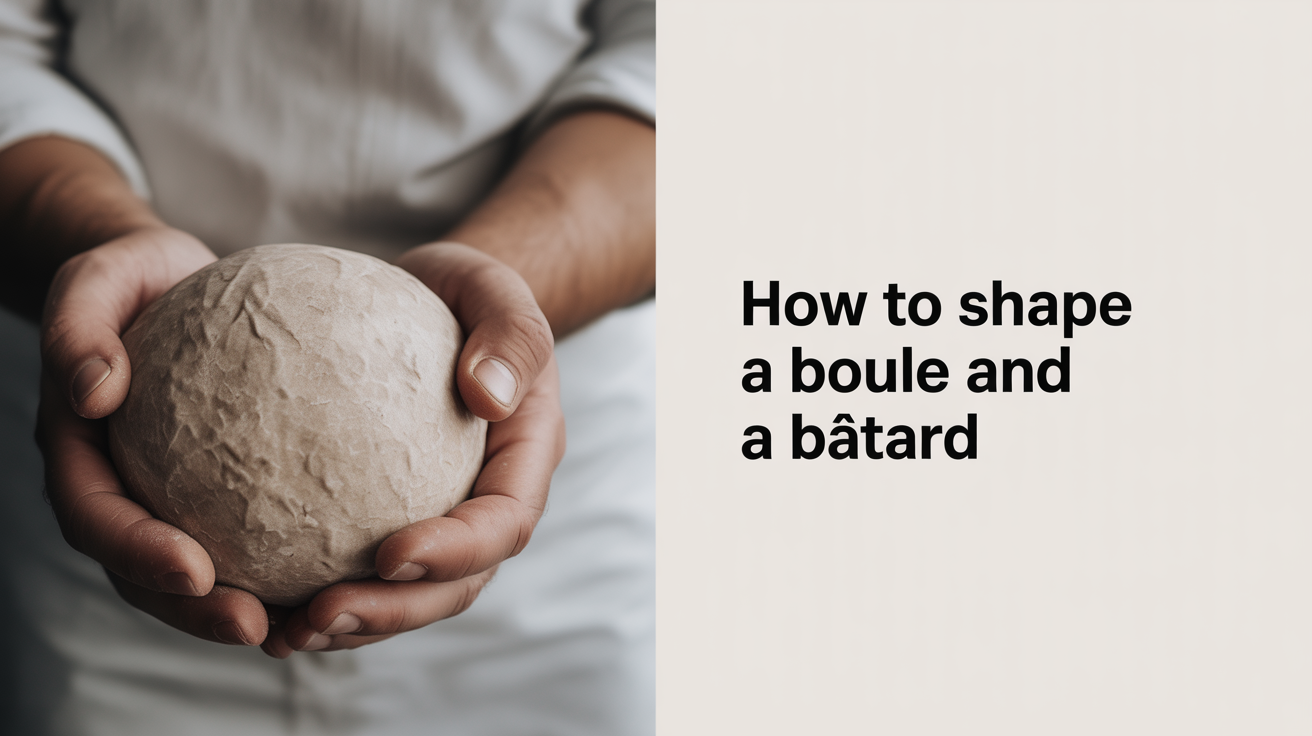
Shaping is the step that turns a blob of fermented dough into a loaf with structure, surface tension, and a predictable oven spring. Two shapes cover most home-baking recipes: the boule (a round) and the batard (an oval). Once you understand the mechanics behind each, you can apply the same logic to almost any loaf you bake.
Why Shaping Matters
After bulk fermentation, your dough is soft, gassy, and relaxed. Shaping does three things:
- Degasses partially. You push out some of the larger bubbles and redistribute the gas for a more even crumb.
- Creates surface tension. Pulling and folding the outer skin of the dough tight gives the loaf a taut surface that holds its shape as it proofs and expands in the oven.
- Establishes a seam. The seam side goes down in the banneton (proofing basket) and faces up on the scoring board before baking, so any tearing happens where you score, not randomly across the crust.
Weak shaping leads to flat loaves that spread sideways. Over-aggressive shaping tears the dough and creates large holes or a dense crumb. The goal is firm but gentle.
A note on bench flour
Use bench flour sparingly. Too much flour on the outside prevents the dough skin from gripping the bench, which is what builds tension. A light dusting of all-purpose flour keeps things moving. Save rice flour for dusting bannetons; it does not absorb into the dough and releases cleanly.
Pre-Shaping: The Step Most Beginners Skip
Pre-shaping is a loose, low-pressure round you do before a rest. It is not optional. Without it, you are trying to build all the tension in one shot, which usually results in dough that tears or fights back.
How to pre-shape
- Turn the dough out of your bulk container onto a lightly floured surface.
- Use a bench scraper in one hand and your other hand to fold the dough from the outside edges toward the center, rotating the dough as you go. Think of it like pulling a blanket in from all sides.
- Flip the dough so the seam side is down.
- Using the bench scraper and your palm, drag the round toward you in a J-shaped motion, using friction with the work surface to tighten the bottom.
- You should see the top of the dough become noticeably tighter and slightly shiny.
You are not trying to build maximum tension here. Aim for a round that holds its shape when you let go but still feels slightly soft in the middle.
Bench rest
After pre-shaping, let the dough rest uncovered on the bench for 20 to 40 minutes. This is called the bench rest. During that time, the gluten network relaxes, which makes the final shaping much easier and reduces tearing. A warmer kitchen means a shorter bench rest; a cold kitchen may need the full 40 minutes.
You can tell the dough is ready when it has spread slightly, the edges have relaxed, and a poke with your finger leaves an indent that fills back in slowly.
How to Shape a Boule
A boule is a sphere. The goal is a tight, even round with no seam showing on top and good surface tension across the whole surface.
Step-by-step boule shaping
- Lightly flour your hands and the surface. Flip the rested pre-shape so the seam side is facing up.
- Fold the top third of the dough down toward the center, pressing lightly to seal.
- Fold the left side toward the center, then the right side.
- Roll the bottom edge up and over to close the package, creating a seam.
- Flip the dough seam-side down.
- Cup your hands around the far edge of the dough and drag it toward you, letting the surface tension pull the top of the round tight. Use friction with the bench rather than gripping hard.
- Give the dough a quarter turn and repeat, rotating around the round until the surface is visibly taut and the top domes slightly.
The motion is similar to cupping the dough under itself rather than pressing down. If the surface tears, you have gone too far; stop and let the dough rest another 5 minutes before trying again.
Transfer to banneton
Dust a round banneton generously with rice flour (or all-purpose). Place the boule seam-side up in the banneton. The seam will open slightly during the cold proof, which is normal.
How to Shape a Batard
A batard is an oval or torpedo shape, roughly 8 to 10 inches long. It works well for scoring patterns and fits inside an oval Dutch oven or a long loaf pan with headroom.
Step-by-step batard shaping
- Flip the pre-shape seam-side up on a lightly floured surface.
- Gently stretch the dough into a rough rectangle, about twice as long as it is wide.
- Fold the top third down and press lightly to adhere.
- Fold the left and right edges in toward the center about one inch on each side, like folding a letter but loose.
- Starting at the far edge, roll the dough toward you, pressing each roll lightly to seal. Think of rolling a sleeping bag: firm enough to hold but not so tight that you compress the interior.
- Finish with the seam running along the bottom.
- Roll the log gently back and forth to even out the shape and build a little additional surface tension. The ends can be left as-is or gently pinched to taper them.
The batard shaping is more linear than the boule technique, but the underlying principle is the same: you are building a taut outer skin by drawing the dough tight against itself.
Transfer to banneton
Use an oval banneton dusted with rice flour, or roll the batard in a floured couche (linen cloth). Place seam-side up for proofing.
Surface Tension: What You Are Actually Trying to Do
Surface tension is the phrase bakers use to describe how tight and elastic the outer skin of the dough feels. Good surface tension means:
- The dough holds its shape rather than spreading flat.
- The oven spring is directed upward and outward rather than sideways.
- Scoring cuts open cleanly and an ear can form on the loaf.
You build tension by pulling the outer skin of the dough across itself. The friction between dough and bench is your main tool; too much flour breaks that friction.
Dough hydration directly affects how easy shaping is. A 65% hydration dough will feel firm and hold shape with minimal effort. A 78% hydration dough will be slack and sticky; it needs faster, more confident moves and a cold (or even partially frozen) bench. If you are new to shaping, starting at a lower hydration gives you more feedback and makes it easier to feel what tension actually is.
Good gluten development before bulk fermentation also makes shaping more forgiving. A well-kneaded or folded dough stretches without tearing, which gives you more room to work. See the guide on how to knead bread dough by hand for what that development should look and feel like.
After Shaping: Cold Proof and Scoring
Once your shaped loaf is in the banneton, cover it and refrigerate for 8 to 16 hours. Cold proofing slows fermentation, improves flavor, and makes scoring easier because the cold dough holds its shape while you work. Bake straight from the refrigerator without letting it warm first.
Score the boule with a single curved slash or a cross. Score the batard with a long angled cut running about 75 percent of the loaf's length. Scoring gives oven spring a controlled place to escape; without it, the loaf bursts wherever the crust is weakest.
To understand how flour, water, and yeast ratios affect dough structure, baker's percentages are the calculation bakers use to compare and scale recipes.
Frequently Asked Questions
Why does my boule flatten out in the oven instead of rising up? Usually this is underproofing, weak shaping, or both. If the dough did not build enough surface tension during shaping, it has nothing to push against and just spreads. Check that your shaped loaf passes the poke test before baking: press one floured finger about half an inch into the dough, then watch how it springs back. Underproofed dough springs back quickly and completely; properly proofed dough springs back slowly and leaves a slight indent.
Can I reshape dough if I make a mistake the first time? Yes, but give it a rest first. If you tear the dough or lose your surface tension mid-shape, gather the dough back into a rough round, cover it, and let it rest 10 to 15 minutes. The gluten will relax and you can try again. Reshaping without rest usually makes tearing worse.
How do I know if my pre-shape is tight enough? The pre-shape does not need to be very tight. It just needs to hold a round shape when you let go. If it flattens completely into a pancake, tighten it a little more. If it resists your hands and tears, you went too far or the dough is not warm enough yet.
What is the seam side and why does it matter where it goes? The seam is the spot where you folded and pressed the dough together during shaping. Placing the seam side down in the banneton keeps it closed during proofing. When you flip the loaf onto your peel or Dutch oven lid before baking, the seam side ends up on top and you score across it. That seam line can also be used intentionally as a rustic score on the underside if you are baking in a covered pot.
Does the shape affect the crumb? The shape itself changes the crumb distribution slightly. A boule produces a more open crumb toward the center of the round. A batard compresses the dough in one direction, which can give a slightly more even crumb from side to side. For most beginner recipes, the crumb difference is minor; the bigger factor is your hydration, fermentation time, and flour choice.