Troubleshooting
Overproofed vs. Underproofed Dough: How to Tell the Difference
Learn the poke test, visual signs, and baked results that separate underproofed from overproofed dough before your next loaf goes in the oven.
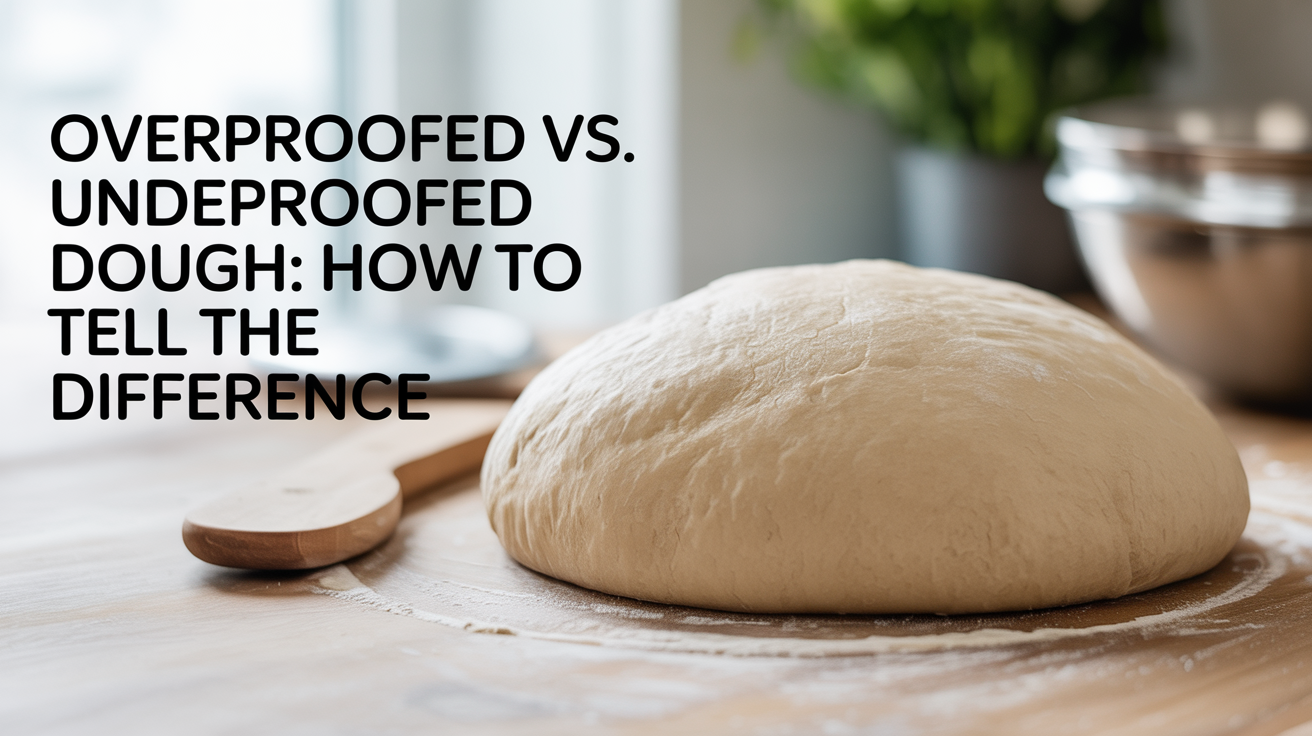
Proofing is the final rise your shaped dough takes before it goes into the oven. It's the stage where yeast fills the gluten structure with gas, turning a dense lump into something light enough to actually bake well. Get it right and you'll pull a tall, open loaf with a crisp crust. Get it wrong in either direction and the results are frustrating but fixable once you know what you're looking at.
The good news: overproofed vs underproofed dough each leave very specific clues. A few seconds of observation (and one quick poke) will tell you exactly where you stand.
What Proofing Actually Does
When you shape a loaf and let it rest, the yeast continues eating the sugars in the dough and releasing carbon dioxide. That gas gets trapped in the gluten network, which is why the dough puffs up. At the same time, the gluten itself relaxes and stretches around those bubbles.
The goal is to catch the dough when the gas cells are full but the gluten is still strong enough to hold the structure in the oven's heat. Too early and the gluten hasn't fully relaxed, so the loaf is tight and heavy. Too late and the gluten starts to break down, the gas escapes, and the dough can't support itself anymore.
Temperature, the strength of your starter or yeast, and how well the dough was shaped all affect how long proofing takes. A recipe's time range is a starting estimate, not a guarantee.
Signs of Underproofed Dough
Underproofed bread hasn't had enough time for the yeast to do its work. The dough feels tight when you handle it, and it often looks smaller than you'd expect for a properly proofed loaf.
Before baking: The surface may look smooth and taut rather than slightly domed and relaxed. Scoring underproofed dough can feel like dragging a blade through rubber.
After baking: This is where underproofing becomes obvious. The loaf is dense and heavy. The crumb is tight with small, irregular holes clustered unevenly. You'll often see a thick, pale band along the bottom where the bread never fully opened. The crust may have "blown out" on the side rather than at the score, because the dough was too tight to expand properly at the slash.
If your bread consistently turns out dense and chewy in an unpleasant way, seven common causes of dense bread covers underproofing alongside other culprits worth ruling out.
What Underproofed Bread Looks Like Inside
Cut into an underproofed loaf and you'll usually see a gummy, compact crumb that pulls apart in chunks rather than tearing cleanly. The holes that are present tend to be flat and horizontal, squeezed down by the unrelaxed gluten. If you've ever sliced a loaf and thought it looked like it needed another hour in the oven, it probably needed another hour before the oven.
Signs of Overproofed Dough
Overproofed dough has gone past the sweet spot. The yeast has exhausted most of its food, the gluten has been stretched beyond what it can recover from, and the dough is fragile.
Before baking: The dough looks very puffy, often more than doubled from its shaped size. It may have a slightly slack, jiggly quality when you move the pan. Pressing it lightly feels like pressing a wet sponge. Scoring it can cause it to deflate or spread sideways rather than opening cleanly.
After baking: Overproofed bread often collapses in the oven or comes out flat. The crust may be pale and wrinkled. The crumb tends to have large, irregular holes near the top with a dense, compressed layer at the bottom where everything fell. The flavor is sometimes sour or yeasty in an off-putting way because the fermentation ran too long.
A collapsed or sunken loaf that comes out gummy in the center is a specific pattern worth understanding on its own. Why your bread is gummy in the middle explains the structure behind that result and what to adjust.
What Overproofed Bread Looks Like Inside
The crumb from an overproofed loaf is often uneven in a particular way: a few very large holes near the top of the slice, then a denser band below. This happens because the weakened gluten couldn't trap and distribute the gas evenly. The top bubbles expanded and merged, while the bottom structure collapsed under the weight.
The Poke Test: A Step-by-Step Guide
The poke test is the most reliable way to check proof level without cutting into the dough. It works by measuring how quickly the gluten springs back from light pressure.
How to do it:
- Lightly flour one fingertip, or dampen it slightly so it doesn't stick.
- Press your finger about half an inch into the dough, straight down. Don't jab, just press gently and pull straight back out.
- Watch what happens over the next 5 to 10 seconds.
What the response tells you:
- Springs back immediately and completely: The dough is underproofed. The gluten is still tight and elastic. It needs more time.
- Springs back slowly, mostly fills in but leaves a small, shallow dent: The dough is ready. The gluten is relaxed but still has enough structure to hold. Bake now.
- Doesn't spring back at all, or the dough deflates noticeably: The dough is overproofed. The gluten is too weak to recover. See the recovery section below.
Practice the poke test on every loaf you bake, even when things go right. Over time you'll build a feel for what "slow spring-back" actually means in your kitchen.
Comparison: Underproofed vs. Just Right vs. Overproofed
| Underproofed | Just Right | Overproofed | |
|---|---|---|---|
| Poke test | Springs back fast, fully | Springs back slowly, slight dent remains | Barely springs back or collapses |
| Look before baking | Smaller than expected, tight surface | Slightly domed, relaxed, holds its shape | Very puffy, slack, jiggly |
| Baked result | Dense, heavy, blown-out side crust | Open crumb, good rise, clean score | Flat, wrinkled, collapsed crumb |
How to Recover Dough in Either State
If your dough is underproofed: Give it more time. Move it somewhere warmer if your kitchen is cool (near a warm oven, or inside the oven with just the light on). The dough hasn't lost anything yet; it just needs more gas production. Check again with the poke test every 15 to 20 minutes.
If your dough is overproofed: The fix depends on how far it's gone. Mildly overproofed dough (still holds its shape, just a little slack) can sometimes be gently reshaped. Remove it from the proofing basket, shape it again without degassing too aggressively, and let it proof again for a shorter period in a cooler spot. This works better with enriched doughs (like brioche or milk bread) than with lean sourdough, because enriched doughs are more forgiving.
Severely overproofed dough (deflated, pooling in the pan, completely limp) is harder to rescue. Some bakers fold it firmly to redistribute the gas cells and let it proof a third time, but the texture won't be ideal. If you're dealing with a yeasted dough, the fastest path is to use the dough for flatbreads or focaccia, where a lower-profile shape masks the structural weakness. For sourdough, the fermentation flavors in overproofed dough can actually make excellent pizza bases.
The deeper lesson is catching it before it goes over. If your dough consistently overproofs before you get to it, check whether your kitchen is too warm or your starter is unusually active. A bread-rise troubleshooting checklist walks through the environmental and fermentation variables that affect timing, which helps you predict the window rather than react to it.
Frequently Asked Questions
Can I bake underproofed dough anyway?
Yes, and sometimes you have to. The loaf won't be at its best. Expect a denser crumb, possibly an uneven blow-out on the side, and a slightly chewier texture. Score more deeply than usual to give the dough somewhere to expand. It'll still be edible, just not ideal.
How long does proofing usually take?
This varies so much that a single number isn't helpful. A warm kitchen with active yeast might proof a loaf in 45 minutes. A cold kitchen with young starter might take 3 to 4 hours. The poke test is more reliable than the clock. Use your recipe's time range as a starting window, then test.
Does overproofed dough taste different?
Often, yes. Very overproofed dough can taste sour, yeasty, or slightly flat because the yeast has consumed most of the available sugars and the organic acids have had extra time to build up. The flavor isn't always unpleasant, but it's noticeably different from a well-timed loaf.
Does the same logic apply to sourdough and commercial yeast?
The signs are the same, but sourdough moves more slowly and the window for "just right" is narrower. Commercial yeast is more predictable and forgiving. If you're learning the poke test, practicing on yeasted doughs first is easier before moving to sourdough timing.
What if my dough collapses when I score it?
That's almost always overproofing. Scoring breaks the surface tension that's helping the dough hold its shape, and if the gluten is already weakened, the whole structure can give way. Try scoring at a shallower angle, use a very sharp blade, and work quickly. Next time, catch the dough a little earlier.