Tools & Ingredients
Why a Kitchen Scale Beats Measuring Cups for Bread
A cup of flour can weigh anywhere from 120g to 170g depending on how you scoop it. Here's why kitchen scale baking fixes that for good.
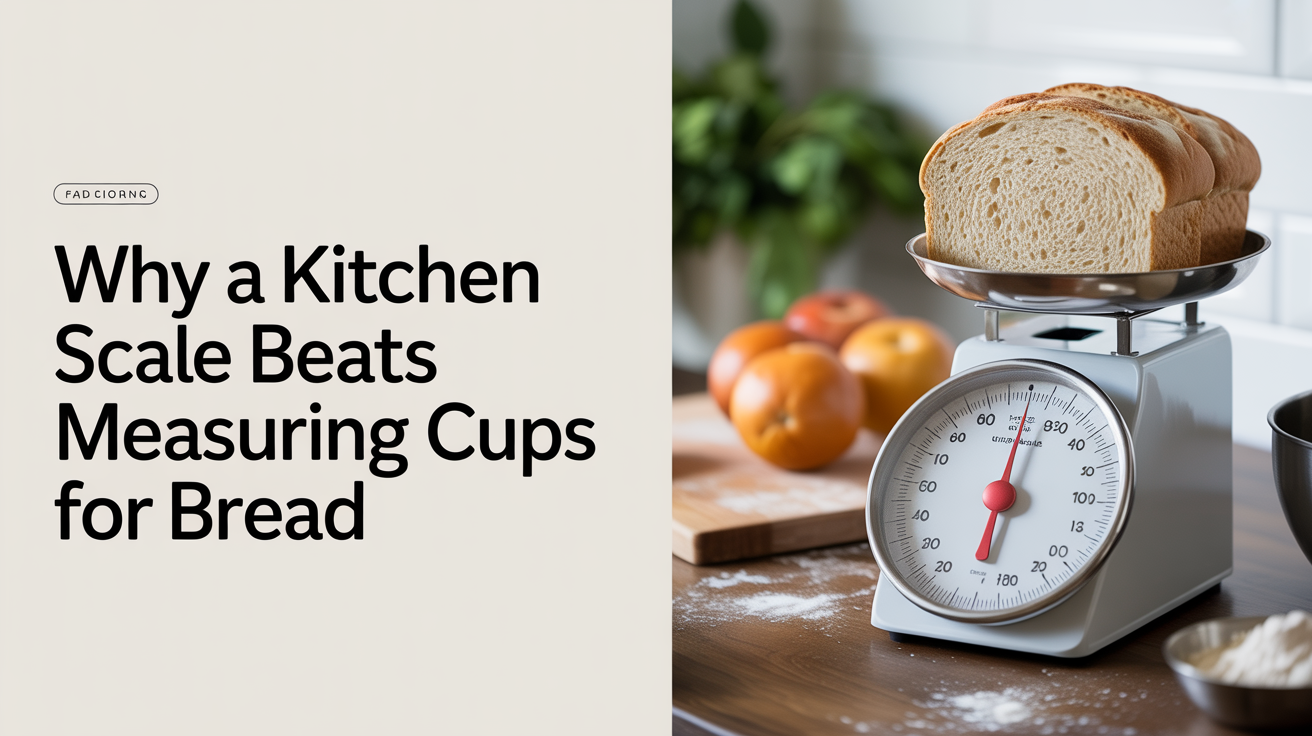
If your loaves come out dense one week and flat the next, and you haven't changed the recipe, the measuring cups are probably the culprit. A cup of all-purpose flour can weigh anywhere from 120 grams to 170 grams depending on whether you scooped it straight from the bag, spooned it in gently, or tapped the cup on the counter. That 40% swing is enough to completely change a dough's texture.
A kitchen scale removes that variable entirely. You add exactly 350 grams of flour every single time, full stop. For bread especially, where hydration determines everything about how a dough handles and how the crumb opens up, precision is not a nice-to-have. It's the difference between a loaf you're proud of and one you feed to the birds.
Why Measuring Cups Fail Flour
Flour is compressible. Tap a cup of flour against the counter and you can pack in 20 to 30 extra grams without filling the cup any higher. Scoop directly from a bag and the flour compresses under the cup's rim. Spoon flour lightly and sift it in, and you'll land closer to 120 grams per cup. All three techniques look the same in the recipe and feel like "one cup," but they produce wildly different doughs.
Salt, yeast, and sugar behave similarly (though the swings are smaller). A teaspoon of fine sea salt weighs roughly 5 to 6 grams; a heaping teaspoon could push 8 grams. In a loaf that calls for 10 grams of salt, that's a meaningful difference in flavor and fermentation.
Volume measurement made sense when home kitchens didn't have scales, and it still works fine for things like chopped onions or a splash of olive oil. For bread baking, where the ratio of flour to water governs whether you have a sticky, open-crumbed sourdough or a tight, dense sandwich loaf, cups simply aren't precise enough.
How Weighing Flour Improves Your Bread
Consistency is the obvious win. Once you find a recipe that works, you can reproduce it exactly. But weighing also opens the door to baker's percentages, which are a much more useful way to read and adapt recipes.
In baker's percentages, flour is always 100% and every other ingredient is expressed as a percentage of that flour weight. A 75% hydration dough means 75 grams of water for every 100 grams of flour. A 2% salt dough means 2 grams of salt per 100 grams of flour. This system lets you scale any recipe up or down to any batch size in seconds, and it lets you compare recipes meaningfully even when they list different flour amounts.
You'll also spend less time on dishes. Instead of measuring cups, tablespoons, and teaspoons, you weigh each ingredient directly into your mixing bowl and tare the scale between additions. No washing a fleet of measuring tools.
Understanding your ingredients matters here too. The difference between bread flour and all-purpose flour is already a factor in how much water your dough can absorb. If you're also introducing cup-measurement variability on top of flour-type variability, troubleshooting becomes very hard. Weighing isolates the flour-type variable so you can actually learn from your bakes.
Common Bread Ingredient Weights
This table gives you approximate gram equivalents for the most common bread measurements. Use these as a reference when converting a volume-based recipe, but always weigh if you can.
| Ingredient | Volume | Approximate Weight |
|---|---|---|
| All-purpose flour | 1 cup | 120 to 125 g |
| Bread flour | 1 cup | 120 to 130 g |
| Whole wheat flour | 1 cup | 120 to 130 g |
| Water | 1 cup | 236 g |
| Fine sea salt | 1 tsp | 5 to 6 g |
| Active dry yeast | 1 tsp | 3 g |
| Instant yeast | 1 tsp | 3 g |
| Honey | 1 tbsp | 21 g |
| Olive oil | 1 tbsp | 14 g |
| Butter (softened) | 1 tbsp | 14 g |
Note that flour weights vary by brand and how the bag has settled. The 120 to 125 g range assumes flour spooned lightly into the cup. A scale removes the ambiguity.
What to Look for in a Kitchen Scale
You don't need an expensive laboratory scale. For bread baking at home, look for these four things:
Capacity and increments
A scale with a 5 kg maximum capacity handles everything from a single loaf to a double batch. More important is the increment: you want 1-gram precision, not 2-gram or 5-gram steps. Small-batch recipes call for 3 grams of yeast or 8 grams of salt. A scale that only reads in 5-gram steps will round those numbers in ways that matter.
Tare function
The tare button zeroes out whatever is on the platform so you can weigh the next ingredient without removing the bowl. This is the feature you'll use constantly. Add flour, tare, add water, tare, add salt. No math, no extra bowls. If a scale doesn't have a responsive tare button, it's not worth owning.
Grams and ounces toggle
Most bread recipes published outside the US use grams. Most published inside the US still use ounces or cups. A scale that switches between the two with one button means you're never converting in your head.
Platform size and readability
A platform wide enough to hold a large mixing bowl is a practical necessity. And the display should be readable with the bowl on top. Some scales have a pull-out display or an angled screen for exactly this reason. Check that the numbers stay visible once your Dutch oven or proofing bowl is sitting on the scale.
The essential bread baking tools for beginners covers a broader kit, but if you're only buying one new tool this month, make it a kitchen scale.
How to Use the Tare Button for One-Bowl Baking
This is the workflow that makes a scale so satisfying to use:
Place your mixing bowl on the scale and press tare. The display reads zero. Add your flour until the display shows your target weight. Press tare again. Add water. Press tare. Add salt. Press tare. Add yeast. Every ingredient lands in the same bowl, measured exactly, and you never do subtraction math.
A few practical notes: always tare after each ingredient, not before. If you overshoot on flour, scoop a little back out with a spoon. (Adding extra water to compensate throws off your hydration ratio, which defeats the purpose.) And if your scale turns off mid-weighing because of an auto-shutoff timer, look for a model with a longer idle timeout or a physical off switch you control.
Liquid ingredients like water or milk are easy to pour slowly and stop. Honey is easier to drizzle in if you've warmed the jar slightly. Salt and yeast go in last so they don't contact each other directly before mixing (especially important if you're using active dry yeast, which is sensitive).
Scaling Recipes Up and Down
Once you're weighing, batch scaling is arithmetic. If a recipe makes one 700-gram loaf and you want two, multiply every ingredient by two. If you want to make a half batch to test a new formula, divide by two. The math stays clean because everything is in grams.
Volume recipes don't scale this cleanly. Half of three-quarters of a cup is not a standard measurement. Half of 90 grams is 45 grams, and you can weigh that precisely.
This is also where baker's percentages become practical. Say you want to test a higher-hydration version of your sandwich loaf. Keep the flour weight the same, increase water by 10 grams, bake, compare. You've changed exactly one thing, and you can record the result clearly. Cup-based baking makes controlled experiments nearly impossible.
For context, understanding how vessel choice affects your crust development is just as important as flour measurement. The Dutch oven question is worth reading alongside this, because steam retention and crust development are the other half of getting bakery-quality results at home.
Frequently Asked Questions
Do I need a kitchen scale if I'm just starting out?
Yes, especially for bread. A basic digital scale costs less than most specialty flours, and it eliminates the single biggest source of inconsistency for beginners. You can always add other equipment later, but start with a scale.
What's the difference between a kitchen scale and a postal scale?
Postal scales often have lower maximum capacities and higher increments (5 grams or more). A kitchen scale rated for 5 kg with 1-gram precision is what you want. Some postal scales happen to meet those specs, but check before assuming.
Can I convert my existing recipes to grams?
Yes. Use the table in this article as a starting point, then verify by weighing one cup of your actual flour bag to see where it lands. Once you've converted a recipe, write the gram amounts in the margins. After two or three bakes with the scale, you won't reach for the cups again.
Does it matter if my scale reads in grams or ounces?
Grams are more useful for bread because baker's percentages and most artisan recipes use them. An ounce is 28.35 grams, which makes mental math harder. Use grams as your default and toggle to ounces only when a recipe forces it.
My scale keeps shutting off mid-weigh. What should I do?
Look for an auto-shutoff setting in the instructions. Many scales let you extend or disable the timer. If yours doesn't, try tapping the tare button lightly to wake it without losing your reading. If that fails, it's a sign to upgrade to a model with manual shutoff control.