Troubleshooting
Why Your Bread Has Huge Holes or No Holes at All
Learn what controls bread crumb structure: hydration, fermentation, shaping, and flour strength. Fix big holes or a tight crumb with this practical guide.
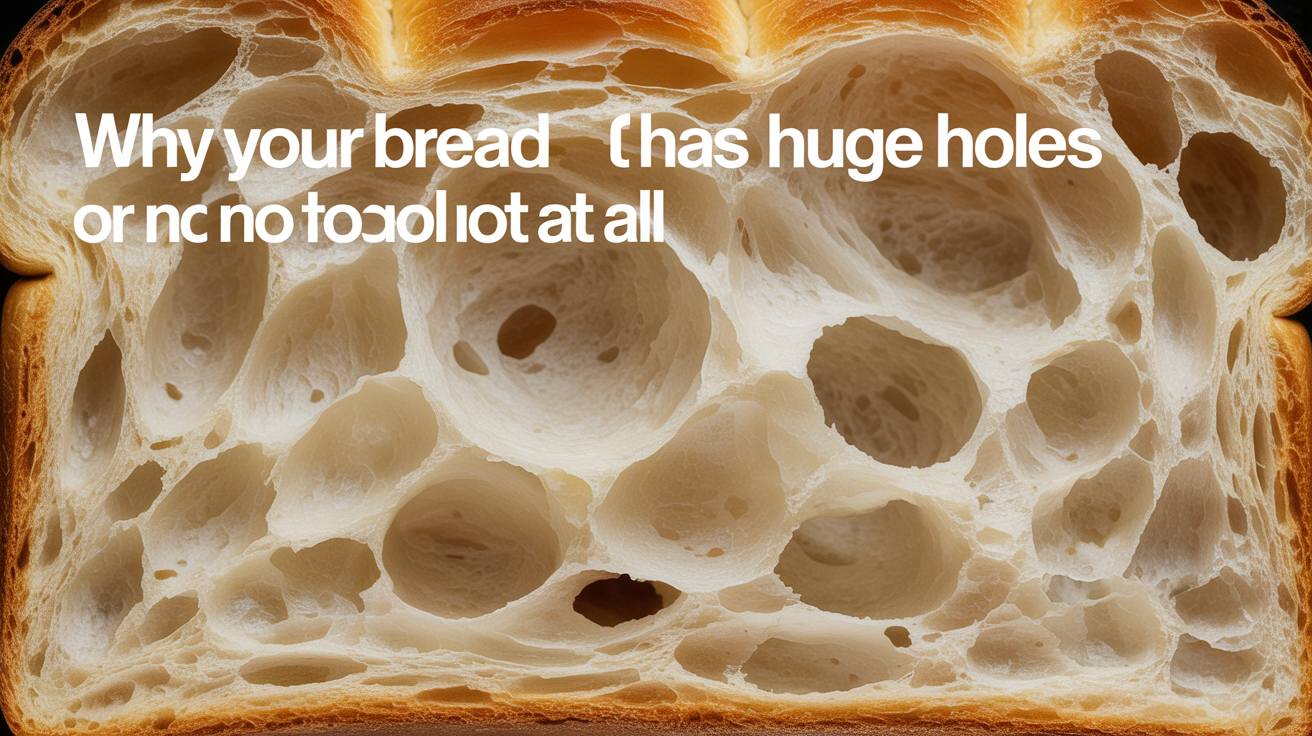
Bread crumb structure comes down to four variables: hydration, fermentation, shaping, and flour protein. When any one of them is off, you end up with either giant tunnels running through the loaf or a crumb so tight it feels more like a rubber eraser than bread.
What "Crumb Structure" Actually Means
The crumb is the interior of your loaf, and its structure is determined by the gas bubbles that form during fermentation. Yeast (or the wild cultures in a sourdough starter) produce carbon dioxide as they eat the sugars in your flour. Gluten, the protein network built when you mix and develop the dough, traps those bubbles. The size, shape, and distribution of the holes you see in a slice are a direct record of how those two things interacted during mixing, bulk fermentation, shaping, and baking.
Bakers talk about open crumb and tight crumb as two ends of a spectrum. An open crumb has large, irregular holes and a glossy, slightly translucent cell wall. A tight crumb has small, uniform, closely packed holes. Neither is a flaw on its own. A rustic sourdough batard is supposed to be open. A sandwich loaf is supposed to be tight. The problems start when your result does not match what you were going for.
The Four Factors That Control Crumb
Understanding these before troubleshooting saves a lot of guessing.
Hydration
Hydration is expressed as a percentage of the flour weight. A dough at 65% hydration contains 65 g of water for every 100 g of flour. Higher hydration (75-85%+) produces a wetter, more extensible dough where gas bubbles can expand freely, which tends toward a more open crumb. Lower hydration (60-68%) produces a stiffer dough that holds smaller, more uniform bubbles, which tends toward a tighter crumb. Enriched sandwich loaves often run 60-65% and include fat and sugar that further tighten the crumb.
Fermentation Time and Temperature
Gas production happens throughout bulk fermentation and proofing. Too little fermentation (underproofed dough) means fewer, larger bubbles with irregular distribution. Too much fermentation (overproofed dough) means the gluten network weakens and the gas escapes, collapsing the structure.
A common target for bulk fermentation is a 50-75% volume increase at room temperature (around 75-78 F / 24-26 C). Cooler kitchens slow things down considerably. At 68 F, the same dough that bulks in 4 hours at 76 F might take 7-8 hours.
Shaping Tension and Degassing
Shaping does two things at once: it distributes the remaining gas evenly through the dough, and it builds surface tension to support the loaf in the oven. If you shape too loosely, large gas pockets survive intact and bake into tunnels. If you degas too aggressively by pressing out every bubble, you deflate the structure you spent hours building.
A firm but gentle pre-shape followed by a 20-30 minute bench rest lets the gluten relax before final shaping, which makes it easier to create even tension without destroying the crumb.
Flour Protein (Strength)
Higher protein flours (bread flour, 12-13% protein) build stronger gluten networks that hold more gas and stretch further before tearing. Lower protein flours (all-purpose at 10-11%, or soft flour below that) build weaker networks. If your recipe was written for bread flour and you substitute all-purpose, you may notice a flatter, tighter crumb even if every other variable stays the same.
Why You're Getting Big Holes
Big holes in bread come in two distinct patterns, and they have different causes.
Irregular Tunnels Near the Top
A large tunnel running horizontally through the upper third of the loaf is almost always a shaping problem. During final shaping, if the surface tension is uneven or if you accidentally trap a large air pocket, it migrates upward during the oven spring and bakes into a tunnel. The fix is to work more deliberately in final shaping: roll or fold the dough to push out obvious air pockets before pulling the surface tight.
Random Large Holes Throughout
Large, uneven holes scattered through the whole loaf point to underproofing or very high hydration dough that was not developed enough. With underproofed dough, the gas is concentrated in fewer, bigger bubbles rather than spread evenly. With a high-hydration dough that lacks gluten strength (from insufficient folds or too-weak flour), the bubbles expand without structure to keep them small.
Common causes and fixes for big holes:
| Cause | What you see | Fix |
|---|---|---|
| Loose shaping / trapped air pocket | One or two large tunnels near the top | Press out air during pre-shape; tighten final shaping |
| Underproofed dough | Large irregular holes, dense patches nearby | Extend bulk fermentation until 50-75% rise; poke test |
| Very high hydration + weak gluten | Huge holes throughout, gummy walls | Reduce hydration by 5%; add 2-3 stretch-and-fold sets |
| Flour too weak for hydration level | Holes collapse, flat loaf | Switch to bread flour or reduce hydration |
Why You're Getting a Tight, Dense Crumb
A brick-like interior with almost no visible holes is its own set of problems. If your loaf is dense, the seven common causes and fixes guide covers that in depth, but the crumb-specific causes are worth naming here.
Low Hydration
At 60% hydration or below, the gluten network is stiff. The dough resists expansion, and the bubbles that do form are small and tightly packed. If you want a more open crumb but your recipe is at 65%, try bumping it to 70% and see how the dough handles it. Whole-grain flours absorb more water, so a whole wheat loaf at 70% may actually behave like a white loaf at 65%.
Overworked or Over-Tightened Dough
Kneading or folding past the point of full gluten development makes the network so tight that gas cannot expand the cells. Signs: the dough feels rubbery and springs back immediately when you poke it. At that point, let it rest 20-30 minutes before doing anything else.
Overproofed Dough
Overproofing breaks down the gluten structure. The dough may look puffy but the cells have already collapsed, so when you bake it, there is no structure left to hold holes open. The result is often both dense and gummy. If your loaf is gummy in the middle as well as tight, the guide to gummy bread explains the overlap.
Yeast or Starter Issues
No gas production means no holes. If your yeast is old or your starter is not active enough, the dough will simply not ferment enough to build any structure. Before mixing, proof commercial yeast in warm water (105-110 F / 40-43 C) with a pinch of sugar for 5-10 minutes. It should foam. For sourdough starter, use it at peak activity, which is when it has roughly doubled and smells pleasantly sour and yeasty. The bread won't rise checklist walks through all the fermentation checks step by step.
Open vs. Tight Crumb: Which Should You Be Aiming For?
The answer depends entirely on what you are baking.
Bread types suited to open crumb (large, irregular holes):
- Rustic sourdough boules and batards (75-80%+ hydration)
- Ciabatta (78-85% hydration, minimal shaping)
- Baguettes (65-68% hydration, long cold fermentation)
Bread types suited to tight crumb (small, uniform holes):
- Sandwich loaves (60-65% hydration, enriched with butter, milk, or egg)
- Soft dinner rolls
- Brioche
- Most whole-grain or multigrain loaves
A tight crumb is practical for sandwiches because it holds fillings without everything falling through. An open crumb is desirable for bread you are tearing apart at the table, dipping in olive oil, or eating with soup, where the irregular texture is part of the point.
If you are following a recipe labeled "sourdough sandwich loaf" and getting giant holes, the problem is real. If you are following a recipe for a rustic country loaf and getting a tight crumb, that is also a problem worth fixing. Match your expectations to what the recipe is actually designed to produce before assuming something went wrong.
Frequently Asked Questions
Is a very open crumb a sign of good sourdough? Not automatically. A wild, irregular crumb in a rustic loaf shows good gluten development and proper fermentation, which are worth celebrating. But an open crumb in a sandwich loaf is a shaping or hydration problem. Open crumb is desirable in the right context, not as a universal quality metric.
Why do bakeries get more open crumbs than home bakers? Commercial ovens generate steam automatically, which keeps the crust pliable longer and allows more oven spring before the crust sets. Home bakers get close to this by using a Dutch oven with the lid on for the first 20-25 minutes of baking. That trapped steam mimics the deck-oven effect and dramatically improves crumb openness.
What hydration should I start at as a beginner? For a white flour sourdough or yeasted boule, 70-72% is a workable starting point. It is wet enough to develop reasonable structure and crumb, but not so slack that it is impossible to shape without experience. Once you can reliably produce a consistent loaf at 72%, you can push toward 75-78%.
Can I fix a dough that already looks overproofed? Sometimes. If it over-proofed during bulk fermentation, try a gentle re-shape to redistribute the gas, then proof again for a shorter time. If it over-proofed in the final proof, the gluten structure may be too far gone. The loaf will still be edible but expect a denser result.
Does the type of flour change the holes I get? Yes, significantly. Strong bread flour (12-13% protein) builds a gluten network that holds bigger bubbles without tearing, supporting a more open crumb. Weaker flours produce smaller, denser bubbles. If you want an open crumb, use bread flour, and make sure it is fresh enough that the protein content is still intact.