Sourdough
Stretch and Fold: How to Build Strength in Sourdough Dough
Learn how to stretch and fold sourdough dough during bulk fermentation to build gluten strength without kneading. Timing, technique, and how to read the dough.
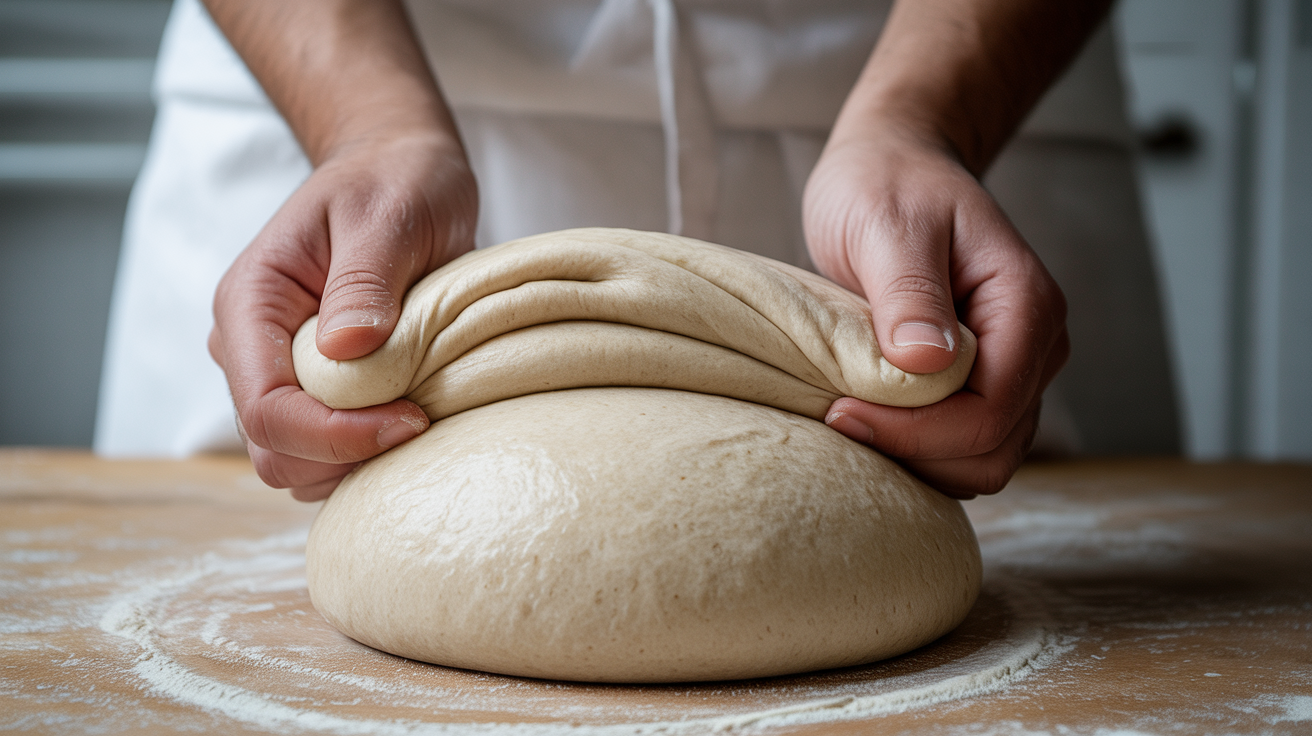
Stretch and fold is a technique bakers use during bulk fermentation to develop gluten structure without traditional kneading. Instead of working all the strength into dough at the start, you build it gradually over several short sessions while the dough ferments.
Why Stretch and Fold Works
Sourdough doughs are typically high in hydration, sometimes 70 to 80 percent water or more. That much water makes the dough sticky and hard to knead by hand on a counter. Even if you did knead it, the extended time needed for sourdough fermentation would mean the gluten network you built right after mixing would have little to do for the next four to six hours.
Stretch and fold solves both problems. You let the dough rest after mixing, which gives the flour time to hydrate fully and gluten bonds to start forming on their own. Then, in short intervals across the first half of bulk fermentation, you extend and fold the dough to progressively align and strengthen those gluten strands. By the time you finish the final set, the dough has enough structure to hold its shape through the rest of the rise and eventually through scoring and baking.
The technique also works flour into full contact with water more evenly than mixing alone does. If your starter is active and well-fed (see how to feed and maintain a sourdough starter for a refresher), good fermentation combined with consistent stretch and fold sets up the gluten network you need for an open crumb and a loaf that keeps its shape in the oven.
How to Stretch and Fold Sourdough Dough
The motion itself is simple once you do it a few times. Here is a step-by-step breakdown.
Wet Your Hands First
Before touching the dough, wet both hands thoroughly under the tap. Do not dry them. Water on your skin prevents the dough from sticking to you, which lets you work cleanly without tearing the surface. Some bakers use a light coating of oil instead, but water is fine and easier to rinse off.
Keep a small bowl of water near your bench so you can re-wet your hands between folds without walking away from the dough.
The Four-Sided Fold
- With your dough still in the bowl or container, reach under one side of the dough with both hands.
- Lift that portion straight up until you feel resistance, usually about 20 to 30 centimeters of stretch.
- Fold it over to the opposite side of the dough mass.
- Rotate the bowl 90 degrees.
- Repeat on the next side.
- Continue until you have folded all four sides. That is one set.
Each complete set takes about 30 to 45 seconds. The dough will feel very slack and extensible on the first set. With each subsequent set, it should feel firmer and more resistant to stretching, which tells you the gluten is developing.
Keep the folds gentle. You are not trying to degas the dough or force it into shape. You are applying tension gradually and consistently.
Coil Folds
Coil folds are a variation that some bakers prefer for very wet doughs or for later sets when the dough has tightened up. To do a coil fold:
- Wet your hands and slide them under the center of the dough.
- Lift the dough straight up from the bowl until the bottom edge releases from the surface.
- Let the front half fall forward and tuck under.
- Set it back down, rotate the container 180 degrees, and repeat on the other side.
That is one coil fold. Do four to six total per set, rotating the container between each one. Coil folds apply tension differently from the four-sided fold and are gentler on the dough surface. Either technique works for building dough strength; use whichever one feels more natural.
Timing: How Many Sets and When
Most sourdough recipes call for three to five sets of stretch and folds, spaced 30 to 45 minutes apart, during the first two to three hours of bulk fermentation. After that, the dough rests undisturbed until bulk is complete.
The following schedule works well for a dough at roughly 73 to 75 percent hydration baked at a kitchen temperature around 24 to 26 degrees C (75 to 78 degrees F):
| Time from mixing | Action |
|---|---|
| 0 min | Mix flour, water, starter, and salt |
| 30 min | Set 1: four-sided folds (4 folds) |
| 60 min | Set 2: four-sided folds or coil folds (4 folds) |
| 90 min | Set 3: coil folds (4 folds) |
| 120 min | Set 4 (optional): coil folds (4 folds) if dough still feels weak |
| 150 min to end of bulk | Rest undisturbed |
Note that timing is a starting point, not a rigid rule. A cold kitchen (below 21 degrees C) slows fermentation, so you might stretch the intervals to 45 minutes and add a fifth set. A warm kitchen (above 27 degrees C) speeds fermentation, so three sets spaced 30 minutes apart is usually plenty.
Measurements to keep in mind: a standard beginner loaf uses around 450 g bread flour, 320 to 340 g water (71 to 75 percent hydration), 90 g active starter (20 percent of flour weight), and 9 g fine salt (2 percent of flour weight). These ratios let you scale up or down while keeping the structure consistent.
If you are still building a starter from scratch or troubleshooting one that is sluggish, see why your sourdough starter isn't rising and how to fix it before starting a dough. Weak starter activity affects bulk fermentation timing and how well the gluten develops during folds.
How to Read Dough Strength
Learning to judge when the dough has enough strength takes a few bakes, but there are reliable signs to watch for.
At the start of bulk: The dough spreads flat in the bowl almost immediately after mixing. It tears if you try to stretch it quickly. It sticks to everything. This is normal.
After the first two sets: The dough holds a rough dome when you complete a set. It pulls back slightly as you fold it rather than flopping over. It still sticks to wet hands but releases cleanly when you let go.
After three to four sets: The dough has a noticeably smoother surface. When you do a coil fold and lift it from the center, the whole mass comes up together rather than sagging apart. It springs back a little when you press a floured finger into it. There are visible bubbles just under the surface.
Ready to shape: Bulk fermentation is complete when the dough has grown by roughly 50 to 75 percent in volume, feels airy and jiggly when you shake the container, and has a domed top with some bubbles. Do not base timing solely on volume; temperature, starter strength, and flour protein content all affect how fast the dough moves.
If the dough tears during folding, you are either pulling too fast or the gluten is still very undeveloped. Slow down the motion and give it a little more time before the next set.
If the dough never tightens up across the sets and remains shapeless and extensible right through the final fold, check your flour protein content. Low-protein flours (below 11 percent protein) build weaker gluten networks. Switching to a high-protein bread flour or adding a small percentage (5 to 10 percent) of whole wheat flour can make a noticeable difference.
Frequently Asked Questions
How many stretch and fold sets do I need to do?
Three to four sets is the practical range for most beginner sourdough recipes. The first two sets do the most work. After that, each additional set adds diminishing returns. If the dough feels strong and extensible after three sets, you do not need a fourth. If it still feels slack, add one more.
Can I skip stretch and fold and just knead the dough instead?
You can, especially at lower hydration levels (below 70 percent water). Traditional kneading builds gluten faster but requires a stiffer dough that is easier to work on a counter. For a high-hydration sourdough, stretch and fold is generally easier and produces comparable results with less effort.
What happens if I forget a set?
Missing one set is not a problem. The dough will still develop structure from the sets you did complete, from the continued fermentation, and from shaping. If you miss all the folds entirely, the final loaf may spread more and have a tighter crumb, but it will still bake.
Should the intervals be exactly 30 minutes?
No. Thirty minutes is a guideline. In a warm kitchen you might compress the intervals to 25 minutes. In a cold kitchen, 45 to 50 minutes between sets still works well. What matters more than the clock is how the dough feels during each set. If it still feels extremely slack after 30 minutes, waiting another 10 to 15 minutes before the next set gives the gluten a bit more time to relax and rehydrate.
Why does the dough sometimes tear when I try to fold it?
Tearing usually means the gluten is tight from recent folding and needs more rest. Wait the full 30 to 45 minutes between sets. Tearing in the very first set can also mean the dough is under-hydrated or the flour did not fully hydrate during the autolyse. Try adding a 20 to 30 minute rest between mixing and the first fold.