Sourdough
Why Your Sourdough Starter Isn't Rising (and How to Fix It)
Sourdough starter not rising? Learn the real reasons it stalls, how to diagnose symptoms fast, and exactly how to revive it.
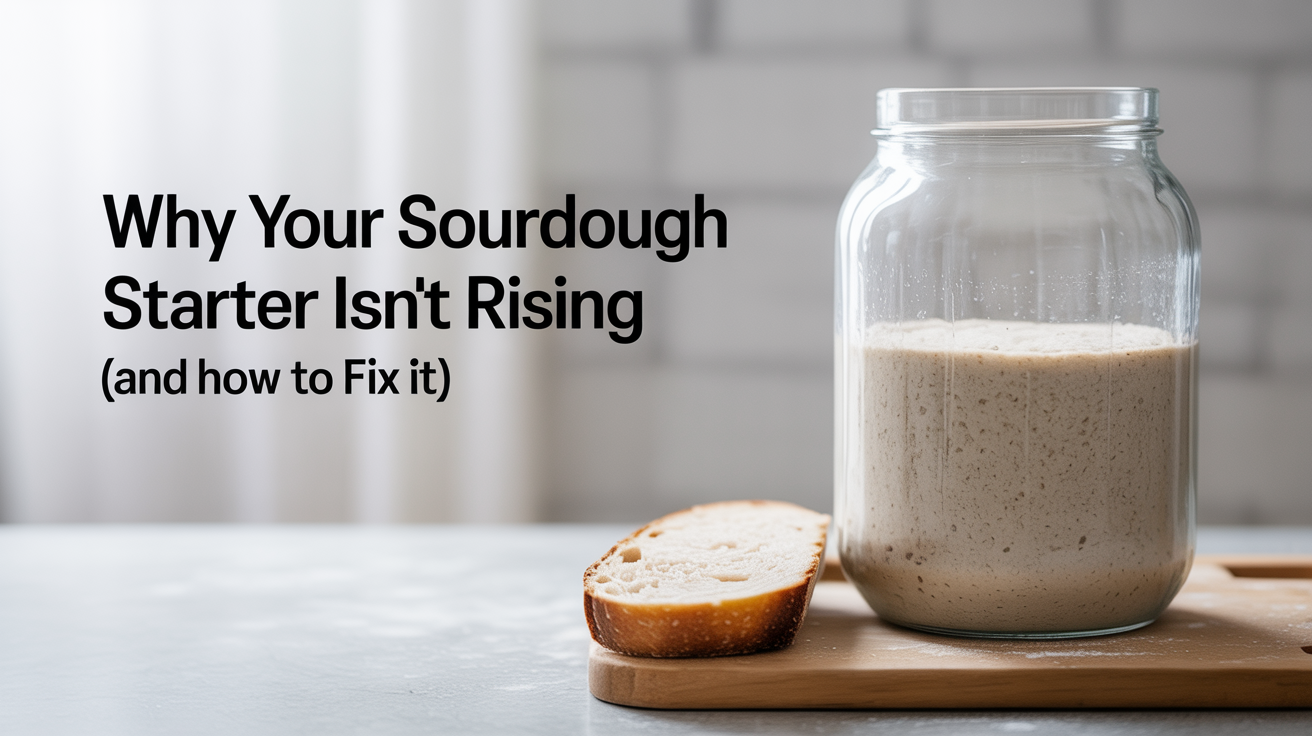
A sourdough starter not rising is one of the most common frustrations for beginners, and it almost always has a fixable cause. Before you throw it out, know this: most stalls come down to three things. The temperature is too low, the starter is hitting a normal lull between days two and four, or it's being fed the wrong flour or ratio. None of these mean failure. They mean you need to make one or two adjustments.
Here's how to figure out what's going on with yours.
At a Glance
- A flat, quiet starter between days two and four is normal, not dead; wild yeast and lactobacillus are still establishing.
- Temperature is the single biggest lever: 75 to 80°F is the sweet spot, and anything below 68°F can stall activity for days.
- Hooch (the dark liquid on top) means hungry, not dead. Stir it in or pour it off, then feed.
- Chlorinated tap water and low-enzyme all-purpose flour can both quietly starve a starter's microbial activity.
- A pink, orange, or fuzzy-mold streak is the one sign that actually means start over; everything else is recoverable.
- Most neglected starters revive within 3 to 5 days on a simple discard-and-feed routine at a warm spot.
The Normal Day-2-to-4 Lull (It's Not Dead)
If you're making a sourdough starter from scratch and it's between two and four days old, a flat, quiet period is completely expected. Many new starters show a burst of bubbles on day one or two from leuconostoc bacteria, then go quiet for a day or two before the wild yeast and lactobacillus colonies establish. This lull is so common it has a name among bakers.
Your starter is not dead. The microbial ecosystem is just reorganizing. Keep feeding it once or twice a day and give it time. The real fermentation activity usually kicks in between days four and seven, sometimes longer in cool kitchens.
Signs you're in a normal lull:
- Smells slightly sour or vinegary (good)
- Has some small bubbles even if it's not doubling
- Was active earlier in the process
Temperature Is the Most Common Culprit
Wild yeast is slow in the cold. If your kitchen drops below 68°F at night, your starter may show very little activity even after a week of feedings. The sweet spot is 75 to 80°F, roughly the same range bakers target for dough temperature right after mixing in yeasted bread. Above that range and fermentation can outpace the yeast's ability to build structure; below it, things crawl.
A few warm spots to try:
- On top of the refrigerator (often 3 to 5 degrees warmer than room temp)
- Inside your oven with just the light on (check with a thermometer first; some oven lights push it past 85°F)
- Next to a warm appliance like a router or coffee maker
If you don't have a kitchen thermometer, get one. A $10 instant-read thermometer is more useful than almost any baking gadget for troubleshooting fermentation problems.
If your kitchen simply doesn't get warm enough no matter where you put the jar, a small proofing box, a seedling heat mat set under the jar with a towel between them, or even a cooler with a mug of hot water swapped out every few hours can hold a steadier 75 to 80°F than chasing warm spots around the house. Consistency matters more than hitting the exact number; a starter held at a stable 76°F will usually outperform one that swings between 68°F overnight and 82°F during the day, even if the daily average looks similar on paper.
Worth knowing: a starter kept at a stable 78°F will usually double in 4 to 6 hours once established, while the same starter at 65°F can take 12 hours or more for the same rise. If you've been judging your starter against a recipe's stated timeline without accounting for your kitchen's actual temperature, that mismatch alone can look like a dead starter when it's simply a slow one.
The Quick-Diagnosis Table
| Symptom | Likely cause | Fix |
|---|---|---|
| Flat and no bubbles, day 1-4 | Normal lull | Keep feeding, wait |
| Flat after day 7, smells fine | Too cold | Move somewhere warmer (75-80°F) |
| Liquid layer on top, sour smell | Very hungry (hooch) | Feed immediately, increase frequency |
| Flat, smells like nail polish remover | Starving, acid buildup | Discard more, feed 1:5:5 ratio |
| No activity after feeding, no smell at all | Chlorinated water or wrong flour | Switch to filtered water, add whole wheat |
| Pink or orange streaks | Contamination | Discard and start over |
| Doubles then collapses within an hour | Overripe, fed too infrequently | Feed twice daily or increase ratio |
Hooch: Hungry, Not Dead
That dark, watery liquid sitting on top of your starter is called hooch. It's alcohol produced by the yeast as a byproduct of fermentation. It looks alarming. It smells sharp and sour. It means your starter is hungry, not dead.
You can stir the hooch back in or pour it off. Pouring it off slightly reduces the acid load, which helps if the starter smells very harsh or like acetone. Then feed it. If hooch is appearing within a few hours of feeding, your starter is active but burning through food too fast. Either increase the feeding ratio or feed twice a day.
According to King Arthur Baking's guide to sourdough starter troubleshooting, hooch of any color, including gray, brown, or black, is a normal sign of hunger rather than a safety problem, and a well-maintained mature starter is genuinely hard to kill through ordinary neglect like an inconsistent feeding schedule. The one exception worth taking seriously is a pink or orange tint or streak, which does signal unwanted bacterial contamination and means the starter should be discarded.
A ratio of 1:1:1 (one part starter, one part flour, one part water by weight) gets consumed quickly. If your starter is hungry after just four or five hours, try 1:2:2 or 1:5:5. The larger ratio gives the yeast more to eat and slows the cycle down. This is especially important to understand once you move into a regular feeding routine.
Chlorinated Tap Water Can Stall a Starter
Chlorine in municipal tap water is there to kill bacteria. That's good for drinking water and bad for sourdough starters, which depend entirely on bacteria and wild yeast. If you've been using tap water and your starter isn't bubbling after a week of consistent feedings, this is worth testing.
Switch to filtered water (a Brita-style pitcher works) or let tap water sit uncovered on the counter for 30 minutes. Chlorine off-gasses relatively quickly when exposed to air. Some bakers use bottled water for the first few weeks to rule this out entirely. If your municipal supply uses chloramine rather than plain chlorine (many cities switched over in the past two decades), it won't off-gas nearly as fast; filtering is the more reliable fix in that case.
If you're on well water instead of a municipal supply, chlorine usually isn't the issue, but very hard or mineral-heavy water occasionally causes its own sluggishness. If you've ruled out temperature, flour, and a normal lull, and your water comes from a well, try a batch built entirely with filtered or bottled water for a few feedings to see if activity picks up before chasing other causes.
Whole Wheat and Rye Flour to Jump-Start Activity
All-purpose flour is nutritionally thin for a starter. Whole wheat and rye flours carry more wild yeast and bacteria on the bran, which gives a sluggish starter a real boost.
You don't need to switch entirely. Try replacing 20 to 25 percent of each feeding with whole wheat or dark rye flour for three or four days. Many bakers see a noticeable uptick in bubble activity within 24 hours. Once the starter is reliably doubling, you can return to all-purpose if you prefer.
A few notes on flour:
- Bread flour works well once a starter is established, but its lower enzyme activity can slow things at the beginning
- Bleached all-purpose flour can be harder to ferment than unbleached
- Stone-ground whole wheat has more natural yeast than finely milled varieties
Step-by-Step Revival Plan for a Neglected Starter
If your starter has been sitting in the fridge for weeks (or months) without feeding, it's likely very acidic and sluggish. The yeast isn't dead, just dormant. Here's how to bring it back.
What you need: filtered water, unbleached all-purpose flour, whole wheat or rye flour, a kitchen scale, a clean jar.
Day 1:
- Pull the starter from the fridge and let it come to room temperature (about 1 hour).
- Discard all but 20 grams.
- Feed with 40g filtered water and 30g all-purpose flour plus 10g whole wheat flour.
- Stir well, cover loosely, and leave at 75 to 78°F.
Day 2:
- The starter may still look flat. This is normal. Discard down to 20g again and repeat the same feed.
- Look for any sign of bubbles or a slightly domed top, even minor ones.
Day 3:
- By now most neglected starters start showing activity. Continue the same feeding schedule.
- If it doubled even once, you're on the right track.
Day 4 and beyond:
- Once it's doubling reliably within 4 to 8 hours of a feeding, it's ready for baking.
- Test with the float test: drop a small spoonful into water. If it floats, active gas is present.
Most neglected starters are fully revived within 3 to 5 days using this routine. A very acidic, long-neglected starter may take up to 7 days.
Once your starter is consistently doubling, it's ready for your first sourdough loaf. A reliable starter is the single most important factor in getting good rise and open crumb.
Frequently Asked Questions
My starter has been going for two weeks and still won't rise. What's wrong?
After two weeks with no activity, you're likely dealing with a combination of problems: temperature too low, chlorinated water, or flour that's too refined. Try all three fixes at once. Move it somewhere warmer, switch to filtered water, and add 20 percent rye flour to every feeding. Give it another five to seven days with twice-daily feedings before reassessing.
Is my starter dead if it smells like alcohol or nail polish remover?
No. That acetone-like smell means the starter is very hungry and has been fermenting for too long since its last feed. Pour off the hooch, discard most of the starter, and feed at a 1:5:5 ratio (1 part starter, 5 parts flour, 5 parts water). Feed every 12 hours and move it somewhere warm. It should recover within a few days.
Can I use whole wheat flour for the entire starter?
You can, though whole wheat starters tend to ferment faster and have a more assertive flavor. The higher enzyme activity in whole wheat can actually make timing trickier once you're baking regularly. A blend, like 80 percent all-purpose and 20 percent whole wheat, gives you the activity boost without making the starter harder to manage.
How long should it take for my starter to double after feeding?
At 75 to 80°F, a healthy, established starter typically doubles within 4 to 8 hours of feeding. In a cooler kitchen (68 to 72°F), it may take 10 to 14 hours. Both are fine for baking as long as the doubling is consistent. If it's taking longer than 14 hours in a warm kitchen, it needs more frequent feedings or a higher proportion of whole wheat flour.
Should I throw out my starter and start over?
Only if you see pink, orange, or fuzzy mold. Everything else, including a flat starter, hooch, acetone smell, or a weeks-long lull, is recoverable. Starting over costs you time and doesn't fix the underlying issue. Identify the cause first (temperature, water, flour, or feeding ratio), fix it, and give the existing starter a chance to recover.
Can overfeeding cause a starter to stop rising?
Yes, though it's less common than underfeeding. If you feed a small starter a very large amount of flour and water relative to its size, you dilute the active yeast and bacteria population so much that there isn't enough starter culture left to leaven the new food quickly. If your starter suddenly went sluggish right after a big feeding, drop back to a 1:1:1 ratio for a few cycles to let the population catch back up before scaling the feed size again.