Getting Started
The Four Ingredients in Real Bread (and What Each One Does)
Flour, water, salt, and yeast. Here's exactly what each ingredient does inside your dough and why every one of them matters.
Real bread has four ingredients. That's it. Flour, water, salt, and yeast. Plenty of bakeries build their whole reputation on loaves made from nothing else, and you can too. Understanding what each one actually does inside your dough makes you a far more confident baker, because you stop following recipes blindly and start making decisions on purpose.
This article breaks down each of the basic bread ingredients, explains the science in plain language, and covers a few common add-ins that change the result when you want something richer than a plain country loaf.
Flour: The Structure
Flour is what gives bread its body. When flour gets wet and you work the dough, two proteins inside it (glutenin and gliadin) link together and form gluten. Gluten is a stretchy, elastic network that traps the gas bubbles produced by yeast. Without it, your loaf would collapse into a dense, gummy brick.
The type of flour you use changes the outcome more than most beginners expect. Bread flour has a higher protein content (typically around 12 to 14 percent) than all-purpose flour (around 10 to 12 percent). More protein means more gluten potential, which means a chewier crumb and a loaf that holds its shape during a long rise. All-purpose flour works perfectly well for most home recipes. You'll just get a slightly softer texture.
Whole wheat flour includes the bran and germ from the wheat kernel. Those components add flavor and nutrition, but the sharp edges of bran actually cut through gluten strands, so whole wheat loaves tend to be denser. Most recipes that use whole wheat blend it with bread flour to keep the structure manageable.
In a standard bread recipe, flour is the baseline. Every other ingredient is measured as a percentage of the flour weight. That's what bakers mean when they talk about hydration, salt percentages, and so on.
Water: The Activator
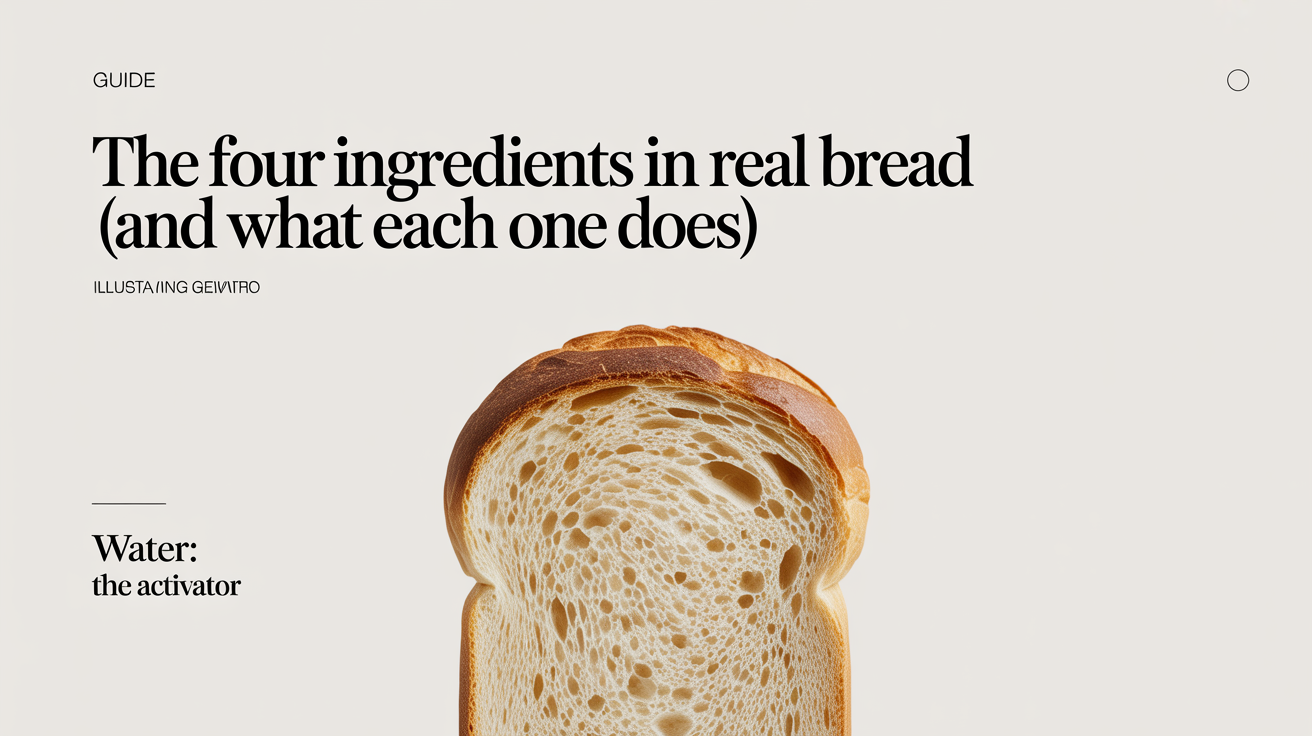
Water is what makes everything happen. It hydrates the flour proteins so gluten can form, activates the yeast so fermentation can start, and dissolves the salt so it distributes evenly through the dough. Without water, you have a bowl of dry ingredients that sit there doing nothing.
The ratio of water to flour is called hydration, expressed as a percentage. A dough with 500g of flour and 375g of water is 75% hydration. Higher hydration doughs (above 75%) produce open, airy crumbs with large irregular holes. Lower hydration doughs (around 60 to 65%) are stiffer, easier to handle, and produce tighter crumbs. If you're just starting out, the no-knead bread method is a great first project because its high hydration and long rest time do most of the gluten development for you.
Temperature matters too. Warm water (around 75 to 80°F) activates yeast quickly. Cold water slows yeast down, which is useful when you want a long, slow fermentation in the refrigerator overnight. Avoid very hot water (above 110°F) around yeast; it kills it.
Water quality is rarely a problem at home, but heavily chlorinated tap water can slightly inhibit yeast. If your tap water has a strong chlorine smell, let it sit in a glass for 30 minutes before using it, or use filtered water.
Salt: The Controller
Salt does three things in bread. It controls how fast yeast ferments, it strengthens the gluten network, and it makes the bread taste like bread instead of cardboard.
On fermentation: yeast produces carbon dioxide through a process called fermentation, and salt slows that process down by drawing water out of the yeast cells through osmosis. This sounds like a bad thing, but slower fermentation is actually better. It gives the dough more time to develop flavor compounds. Bread that ferments too fast tastes flat and a little plasticky. Bread that ferments slowly has more complexity and a better crust.
On gluten: salt tightens and strengthens the gluten network. Dough made without salt is noticeably slack and sticky. It also tends to over-ferment quickly, which weakens structure. Adding salt gives you a dough that's easier to shape and holds its form in the oven.
A typical bread recipe uses around 2% salt by flour weight, which works out to about 10g per 500g of flour. That's enough to do the job without tasting salty. If you add salt directly on top of active yeast with very little water around, it can slow the yeast sharply, so most bakers add salt and yeast to opposite sides of the bowl before mixing, or add the salt after the dough comes together slightly.
Yeast: The Engine
Yeast is a living organism. It eats the sugars present in flour and produces carbon dioxide gas as a byproduct. That gas gets trapped in the gluten network and makes your dough puff up. When the dough goes into a hot oven, the gas expands rapidly (this is called oven spring) and the structure sets. That's what you're eating when you eat bread with an open crumb.
Home bakers use a few forms of yeast. Instant yeast (also called rapid-rise or fast-action yeast) is the simplest: add it directly to your dry ingredients with no proofing step. Active dry yeast needs to be dissolved in warm water for five to ten minutes before mixing, though many bakers skip this step without issue. Fresh yeast is available at some specialty stores; it's highly perishable but works beautifully.
Sourdough is a different approach entirely. Instead of commercial yeast, you use a sourdough starter, which is a culture of wild yeast and lactic acid bacteria that you maintain by feeding it flour and water regularly. Wild yeast ferments more slowly than commercial yeast, and the bacteria produce acids that give sourdough its characteristic tang. The flavor is more complex, but the process takes longer and requires a bit more attention.
If you want to skip the measuring and get a feel for how dough actually comes together, making bread by hand with no special equipment is a good way to learn the basics before worrying about hydration percentages and yeast types.
How the Four Work Together
None of these ingredients work in isolation. The magic is in how they interact.
Water hydrates flour to form gluten and wakes the yeast. Yeast starts consuming sugars and producing CO2. Salt slows the yeast just enough to give gluten time to develop and flavor time to build. The gluten network stretches around the gas bubbles and holds them in place. Heat collapses the yeast (it dies above around 140°F), sets the gluten into a permanent structure, and caramelizes the crust.
This is why the ratio of these four ingredients matters. Change the water percentage and you change the crumb texture. Change the salt percentage and you change the crust color, the fermentation speed, and the final flavor. Cut the yeast amount and you get a longer, slower rise that often produces better flavor.
| Ingredient | Primary Role | Typical Baker's Percentage |
|---|---|---|
| Flour | Structure (gluten network) | 100% (baseline) |
| Water | Hydration, gluten activation, yeast activation | 65–80% |
| Salt | Gluten strengthening, yeast control, flavor | 1.8–2.2% |
| Yeast (instant) | Fermentation, leavening | 0.5–1% |
Once you understand this, a recipe stops being a list of steps and starts making sense as a system. If you want to put it into practice right away, this complete beginner's guide to baking your first loaf walks through the whole process from mixing to eating.
Common Add-Ins and What They Change
Many breads stick to flour, water, salt, and yeast. But plenty of recipes add other things. Here's what the most common ones do.
Fat (butter, olive oil, lard). Fat coats gluten strands and makes them shorter, which gives you a softer, more tender crumb. It also slows staling because fat molecules interfere with the starch retrogradation process that makes bread go hard. Sandwich breads and brioche both rely on fat for their soft texture. Artisan sourdough loaves typically use none.
Sugar (white sugar, honey, molasses). A small amount of sugar (1 to 2%) gives yeast an easy food source and speeds fermentation. It also promotes browning through the Maillard reaction and caramelization, which is why enriched breads have deeper golden crusts. Large amounts of sugar actually inhibit yeast, so very sweet doughs (like cinnamon roll dough) need more yeast to compensate.
Milk. Replacing water with milk adds fat, protein, and lactose. The result is a softer crumb and a richer flavor. Milk also promotes crust browning. Most dinner rolls and soft sandwich loaves use milk for this reason.
Eggs. Eggs add fat and protein, which both enrich the crumb. They also add color (from the yolk) and help the loaf hold together. Brioche, challah, and many enriched sweet breads include eggs. The added protein also means these doughs can handle more gluten development without becoming tough.
None of these add-ins are necessary for what is bread made of at its most fundamental level. They're tools to change texture, flavor, and shelf life when you want something different from a plain loaf.
Frequently Asked Questions
Can I make bread with just flour and water?
You can, but the result depends entirely on what you're making. Flatbreads like tortillas or chapati use just flour and water. For a risen loaf, you also need a leavening agent, whether that's commercial yeast, a sourdough starter, or baking powder (for quick breads). Without something to produce gas, the loaf won't rise.
Does the type of flour really matter that much?
Yes. Protein content directly affects gluten development, which affects how much your dough rises and how chewy the final crumb is. For most beginner recipes, all-purpose flour works fine. If you want a chewier artisan loaf or you're making pizza dough, bread flour is worth the switch.
What happens if I forget to add salt?
The dough will ferment faster than expected (sometimes much faster), the gluten will be weaker and slacker, and the finished loaf will taste bland. Salt is not optional in a standard bread recipe. If you've already mixed a saltless dough and haven't started the first rise yet, dissolve the salt in a teaspoon of water and knead it in. It takes a few minutes but works.
Can I reduce the yeast to slow down the rise?
Yes, and many recipes do this intentionally. Using 0.1 to 0.25% instant yeast instead of the standard 0.5 to 1% and leaving the dough to rise in the refrigerator overnight produces excellent flavor. The long, cold fermentation gives enzymes more time to break down starches and develop complexity. This is one of the simplest ways to improve a basic loaf without changing anything else.
Is sourdough really just flour and water?
A sourdough starter is made from flour and water, yes. But the loaf itself still uses those same four ingredients: flour, water, salt, and the natural yeast from the starter. The difference is where the yeast comes from (wild, cultivated in the starter) and the additional flavor contribution from lactic acid bacteria. The fundamentals are the same.