Tools & Ingredients
Why Salt Matters in Bread (and What Happens Without It)
Salt does far more than add flavor in bread dough. Learn its role in gluten, fermentation, browning, and how much to use by weight.
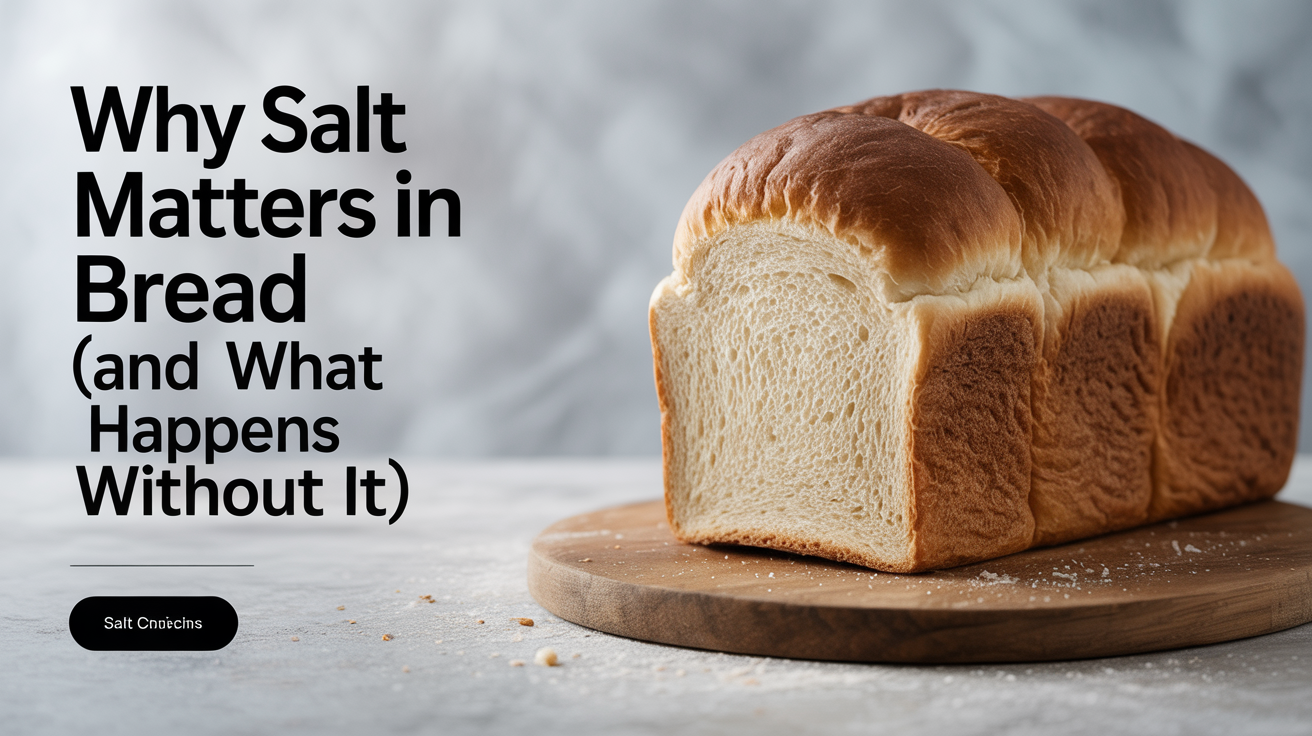
Salt is one of the four basic ingredients in most bread recipes, and it pulls more weight than any other component except flour. Leave it out once and you will understand immediately why it belongs there.
What Salt Actually Does in Bread Dough
The role of salt in bread covers at least four distinct jobs. Understanding each one helps you make better decisions at every stage of mixing and baking.
Flavor
Salt suppresses bitterness and rounds out the flavors that fermentation develops. Without it, those same compounds that give a good loaf complexity just taste flat or faintly bitter. Salt does not simply make bread "salty." It makes the wheat taste more like wheat, the crust taste more like crust, and the crumb taste more like something worth eating.
Most bread recipes land between 1.8% and 2.2% salt by baker's percentage. At 1.8%, flavor is noticeably mild. At 2.2%, the bread tastes seasoned. Most home bakers find 2% a reliable starting point.
Gluten Strength
Salt tightens the gluten network by increasing electrostatic interactions between protein strands. A dough mixed without salt feels noticeably different: stickier, slacker, and harder to handle. It tears easily and spreads sideways in the oven rather than springing up.
With salt in the mix, gluten bonds pull together more firmly. The dough holds its shape during bulk fermentation, resists tearing during shaping, and keeps enough structure to trap gas and produce an open crumb after baking.
This effect is why some bakers add salt a few minutes after the initial mix (after a short autolyse), rather than holding it out for hours. A long salt delay weakens gluten just enough to make early mixing easier, but the salt still needs to be incorporated thoroughly before fermentation picks up.
Fermentation Rate
Salt slows yeast activity by drawing water out of yeast cells through osmosis. This is not a problem. It is actually useful.
A dough without salt ferments aggressively. Gas production outpaces gluten development, the structure cannot hold all that gas, and the dough over-proofs quickly and collapses. With the right amount of salt, fermentation moves at a pace the gluten can keep up with. You get better flavor development, more predictable timing, and a more consistent result.
For sourdough, salt also moderates wild yeast and bacterial activity. Too little salt and your bulk fermentation window narrows sharply, making it harder to catch the dough at the right point.
Crust Color
Salt helps the Maillard reaction that browns the crust. Unsalted bread bakes up pale and anemic-looking even when the interior is fully cooked. Properly salted dough develops that deep amber to mahogany crust color that signals a good bake.
How Much Salt to Use
Salt is measured as a percentage of total flour weight, which is the standard baker's percentage approach. If you are not yet weighing your ingredients, this is one more reason to start: a kitchen scale gives you far more accuracy than measuring cups, and salt is light enough that a small mismeasure matters.
Salt Percentage by Bread Type
| Bread Type | Salt % (baker's) | For 500 g flour |
|---|---|---|
| Rustic sourdough boule | 2.0–2.2% | 10–11 g |
| Sandwich loaf | 1.8–2.0% | 9–10 g |
| Focaccia | 2.0–2.5% | 10–12.5 g |
| Bagels | 1.5–1.8% | 7.5–9 g |
| Flatbreads (pita, naan) | 1.5–2.0% | 7.5–10 g |
| Pizza dough | 2.0–2.5% | 10–12.5 g |
These are starting points. Your taste, your flour's protein content, and your preference for a more or less salty crust will all pull the number slightly one way or the other.
How to Calculate Salt by Weight
Multiply your flour weight in grams by your target percentage as a decimal.
- 500 g flour x 0.02 = 10 g salt (2%)
- 750 g flour x 0.02 = 15 g salt (2%)
- 1,000 g flour x 0.018 = 18 g salt (1.8%)
That is all the math involved. Keep in mind that different flour types absorb water differently, but the salt percentage stays the same regardless of hydration or flour type.
What Bread Without Salt Looks and Tastes Like
Baking a saltless loaf by accident is a frustrating experience, but it is a useful one to understand.
Flavor: Flat, bland, and slightly bitter. The wheat flavor is still there, but it reads as raw and one-dimensional. Even a light dusting of flaky salt on a slice helps, but it cannot fix the crumb or the structure after the fact.
Texture: The crumb is often gummy or dense. Without salt tightening the gluten, gas bubbles tend to merge into larger irregular pockets rather than forming an even, open structure. The dough may also spread more than expected during final proof, losing height before it even reaches the oven.
Crust: Pale and soft. The crust may look underdone even when the interior registers the correct temperature (typically 95 to 99 degrees C for a lean loaf). No amount of extra baking time will develop the same color that properly salted dough achieves.
Handling: The dough itself is noticeably sticky and extensible, and it resists holding a shape during the bench portion of shaping. It is a useful reminder of how much salt contributes to a workable, responsive dough.
If you realize you forgot salt after mixing, you can still add it. Dissolve it in a small amount of water (about 1 teaspoon of water per 10 g of salt), then fold it into the dough through a series of stretch-and-folds. It takes several folds to distribute evenly, but the dough will recover.
When and How to Add Salt
Most recipes call for salt to be added at the beginning of the mix, along with flour and water. That is a reliable approach. The salt integrates evenly, gluten develops under its full influence from the start, and you do not have to remember a separate step.
Some recipes use a short autolyse: the flour and water rest together for 20 to 60 minutes before salt and yeast are added. The reason is that flour hydrates fully before gluten begins to develop, which can improve extensibility. Salt is held out only for that rest period, then added at the start of kneading. Holding salt out for longer than the autolyse window is not standard practice for home baking and can lead to over-fermentation before the salt is incorporated.
One practical note: do not pile salt and dry yeast directly on top of each other before mixing. Scatter them on opposite sides of the bowl, or mix flour and water first, then add both. Once everything is wet, the concentration drops and there is no concern.
Salt Types and Whether They Matter
Fine sea salt and table salt are the most common options for home bakers, and they work interchangeably by weight. If you are measuring by weight with a scale, the type does not matter much.
Where it gets confusing is volume. One teaspoon of table salt weighs roughly 6 g. One teaspoon of Diamond Crystal kosher salt weighs roughly 3 g. Morton kosher sits in between at about 4.8 g per teaspoon. If a recipe gives salt in teaspoons rather than grams, the type of salt matters a great deal. This is another reason why grams are more reliable.
Iodized table salt is sometimes said to inhibit sourdough starter cultures. The evidence for this is inconsistent. At normal bread-making levels (2% of flour weight), iodized salt has not been shown to have a meaningful effect on fermentation. Fine sea salt is a reasonable default, but it is not necessary to seek out anything specialty.
Fine sea salt is a reasonable default and works well in every application. If you are baking in a Dutch oven, the salt in your dough performs the same regardless of the brand on your shelf.
Frequently Asked Questions
Can I reduce the salt in a recipe if I am watching sodium intake?
You can drop to around 1.5% and still get a reasonable loaf. Below 1.5%, the structural and fermentation effects become noticeable: the dough will be slacker, fermentation will move faster, and flavor will be noticeably flat. If sodium is a concern, a smaller slice of a properly salted loaf is often a better approach than making a structurally compromised bread.
Why does some artisan bread taste saltier than supermarket bread?
Most commercial sandwich bread is baked to 1.5 to 1.8% salt, partly for cost and partly because many consumers find lower-sodium products more palatable on their own. Artisan-style loaves with a thick crust concentrate the salt toward the surface during baking, which reads as more intensely seasoned even at the same total percentage.
Does salt affect how long bread stays fresh?
Salt is mildly hygroscopic, meaning it holds onto some moisture. Properly salted bread tends to stale slightly more slowly than unsalted bread because of this effect. It is a minor factor compared to storage conditions, but it is real.
What if I accidentally used too much salt?
Over-salted bread is not ruined, but it will taste visibly salty and the crust may brown faster than expected. If the dough is not yet baked, you cannot easily remove salt. The best fix is to add more flour and water to dilute the percentage, which means mixing a second batch without salt and combining the two. Above 3% salt, yeast activity is significantly slowed, so over-proofing becomes less of a worry but under-proofing is possible.
Does the salt percentage change for enriched breads with butter and eggs?
Not by much. Enriched doughs like brioche or milk bread still use 1.8 to 2% salt on the flour weight. If the recipe already includes salted butter, you might reduce the added salt by 0.2 to 0.3% to compensate, but this is optional. Taste the finished crumb and adjust next time if it seems off.