Yeasted Breads
How to Make Whole Wheat Sandwich Bread That Isn't Dense
Fix dense, heavy whole wheat sandwich bread with more hydration, a longer autolyse, and a bit of enrichment. Full recipe with gram weights included.
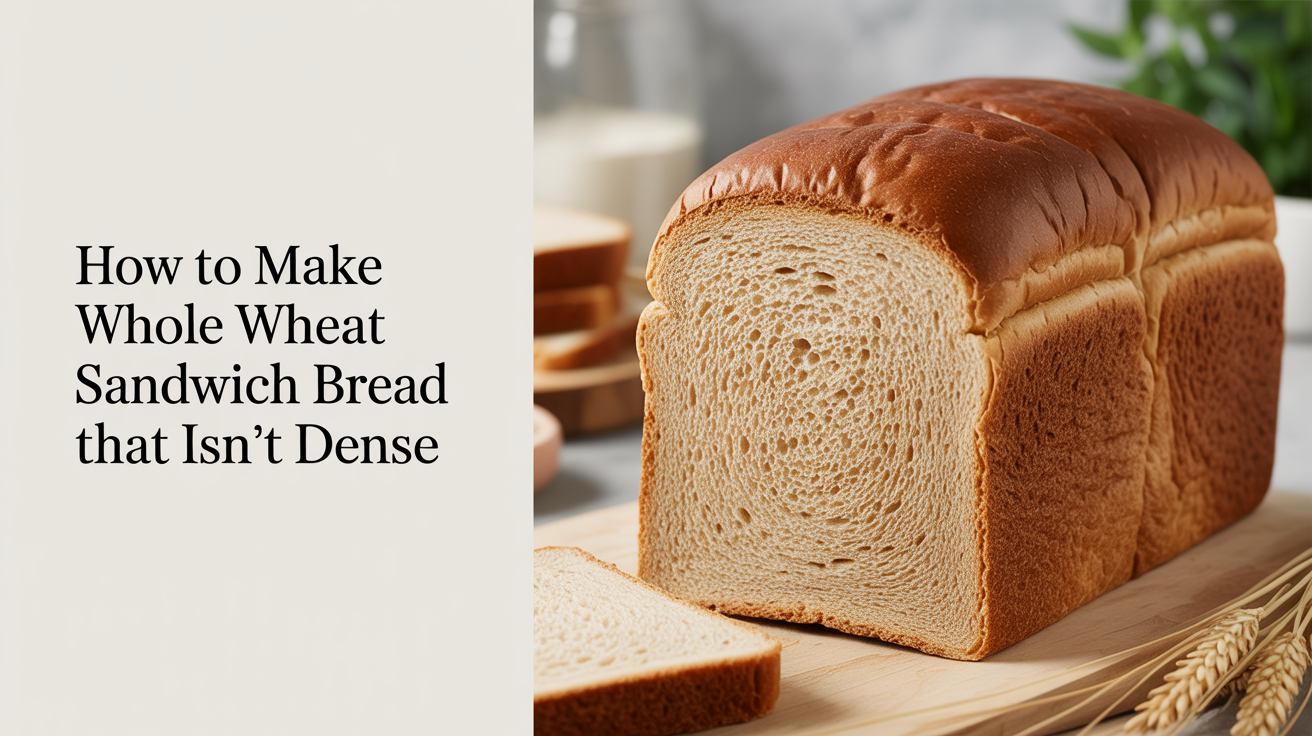
If you've swapped whole wheat flour into a familiar white sandwich bread recipe and pulled out something closer to a brick than a loaf, you're not alone, and you didn't do anything wrong. Whole wheat sandwich bread behaves differently from a dough made with all-purpose or bread flour, and it needs its own approach instead of a straight substitution. Adjust the hydration, give the dough more time, and add a little enrichment, and you get a loaf that's tall and soft enough for a sandwich, not a dense brick you eat out of obligation.
Why Your Whole Wheat Loaf Comes Out Dense and Heavy
Whole wheat flour isn't just white flour with color added. It's milled from the entire wheat kernel, bran, germ, and endosperm together, while white flour and bread flour keep only the endosperm. That bran is the real problem for texture. Those sharp little flecks act like tiny blades inside the dough, slicing through gluten strands as you knead and while the dough rises. Fewer intact gluten strands means less structure to trap gas, and less trapped gas means a shorter, denser loaf no matter how long you knead or how patiently you let it proof.
The germ adds its own complication. It's full of natural oils, which is part of why whole wheat flour goes rancid faster than white flour. Those oils coat some of the flour's proteins before they get a chance to link into gluten, which is one more reason whole wheat dough builds strength more slowly than a dough made with a higher-protein flour. If you want the fuller picture of how flour type changes what your dough can do, our guide to flour protein and specialty flour types walks through it in detail.
None of this means a 100 percent whole wheat loaf has to be dense. It means the flour needs help white flour doesn't: more water, more time, and usually a bit of extra yeast or enrichment to make up for what the bran and germ take away.
The Fixes: More Water, a Longer Autolyse, and a Little Enrichment
Once you understand what whole wheat flour is doing to the dough, the fixes stop feeling random and start making sense.
Add more water than you think you need. Bran is thirsty. It keeps absorbing water for hours after mixing, which is why a whole wheat dough that feels workable at first can turn dry and tight by the time you're ready to shape it. Most white sandwich bread recipes sit around 60 to 65 percent hydration; a 100 percent whole wheat loaf usually wants 75 to 80 percent to land on a comparable crumb. If hydration is a new term to you, this explainer on dough hydration covers how the ratio of water to flour changes stickiness, rise, and final texture.
Give the dough a longer autolyse. An autolyse is simply mixing flour and water and letting the mixture rest, with no yeast or salt yet, before doing anything else. For white flour, 20 to 30 minutes is plenty. For whole wheat, stretch that to 45 minutes or a full hour. The extra time lets the bran fully soften and gives the flour's own enzymes a head start on building gluten before you ever start kneading, so you get more structure for less physical effort.
Add a touch of enrichment. A tablespoon or two of honey, oil, or melted butter does real work here. Fat coats the gluten strands and keeps the crumb tender instead of tough, and a little sugar from honey feeds the yeast and helps the crust brown, since plain whole wheat dough can bake up pale without it. Some bakers also bump the yeast by 20 to 30 percent to compensate for the denser structure working against the rise. None of these changes is dramatic alone, but together they add up to a loaf worth eating instead of one that sits in the bread box unfinished.
A Full 100 Percent Whole Wheat Sandwich Bread Recipe
This recipe uses all three fixes together and makes one generous loaf in a standard 9 by 5 inch pan. Weigh your ingredients if you can. Whole wheat flour is dense and inconsistent by volume, and grams will save you from the dry, crumbly loaves that come from scooping flour straight out of the bag.
| Ingredient | Weight | Baker's percentage |
|---|---|---|
| Whole wheat flour | 500g | 100% |
| Water, warm | 375g | 75% |
| Instant yeast | 7g | 1.4% |
| Honey | 30g | 6% |
| Neutral oil | 30g | 6% |
| Fine sea salt | 10g | 2% |
Mix and autolyse. Combine flour and water in a large bowl until no dry patches remain. Cover and rest 45 minutes at room temperature.
Add the rest. Sprinkle the yeast, honey, oil, and salt over the dough and mix until combined, by hand or on low speed with a dough hook. Knead 8 to 10 minutes by hand, or 5 to 6 minutes in a stand mixer, until smooth, elastic, and only slightly tacky.
Bulk ferment. Cover the bowl and let the dough rise until roughly doubled, 60 to 90 minutes depending on your kitchen's warmth. The color makes whole wheat dough harder to judge by eye, so lean on the poke test instead: a gentle dent should spring back slowly without fully disappearing.
Shape. Turn the dough out, press out the larger gas bubbles, and shape it into a tight log to fit your loaf pan.
Final proof. Place the shaped dough in a greased pan, cover loosely, and let it rise until it crests about an inch over the rim, roughly 45 to 60 minutes.
Bake. Bake at 375°F (190°C) for 35 to 40 minutes, tenting with foil after 20 minutes if the top browns too fast. It's done when the loaf sounds hollow tapped on the bottom and reads about 200°F (93°C) at the center.
Cool completely, at least two hours, before slicing. Cutting into a hot loaf squashes the crumb and makes it look gummier than it is.
Shaping for an Even, Tall Rise
Shaping matters more with whole wheat than with a forgiving white dough, because you don't get a second chance to build gluten once the loaf is in the pan. A loose, uneven shape bakes into a loaf with a lopsided top and weak side walls. Roll or pat the dough into a rectangle roughly the width of your pan, then roll it up tightly from the short end, pinching the seam closed as you go. That tight spiral gives the loaf even internal structure, so it rises straight up instead of ballooning to one side.
For a full walkthrough of hand position and common shaping mistakes, see our step-by-step guide to shaping a sandwich loaf for an even, tall rise. It applies to any enriched sandwich dough, whole wheat included, and it's worth five minutes if your loaves have been coming out lopsided.
If 100 Percent Whole Wheat Feels Like Too Much Right Now
There's no rule that your first whole wheat loaf has to be entirely whole wheat. Plenty of bakers start by replacing 25 to 50 percent of the bread flour in a trusted white sandwich recipe with whole wheat, then raise that ratio over a few bakes as they get a feel for the dough. A 50/50 blend still gives real whole grain flavor, with the bread flour's higher protein propping up the structure while you learn to read whole wheat dough by touch.
If you want a starting point for that blended approach, our base soft sandwich bread recipe is a good place to begin. Swap in whole wheat gradually, nudging the water upward each time, using the hydration increase above as your guide. A loaf you enjoy eating at 50 percent whole wheat beats a dense brick at 100 percent every time.
Frequently Asked Questions
Why is my whole wheat bread gummy in the middle instead of dense?
Gumminess usually points to undercooking or slicing too soon, not underhydration. Whole wheat crumb holds moisture differently than white bread, so it can look gummy even at a safe internal temperature if you cut into it while still warm. Check for 200°F (93°C) at the center with a thermometer, then let the loaf cool for a full two hours before slicing.
Can I use whole wheat pastry flour instead of regular whole wheat flour?
No. Whole wheat pastry flour is milled from soft wheat and carries much less protein, so it won't build the gluten structure a sandwich loaf needs. Look for whole wheat bread flour, or standard whole wheat flour milled from hard red or hard white wheat.
Do I need to knead whole wheat dough longer than white dough?
Not necessarily longer by the clock, though it can feel like more effort since the bran interferes with gluten development. Watch the dough instead of the timer. It's ready when it's smooth and passes a rough windowpane test, stretching thin without tearing right away.
Why did my loaf collapse or sink in the middle after baking?
That's almost always overproofing. Whole wheat dough at this hydration and enrichment level can go from ready to overproofed faster than you'd expect, especially in a warm kitchen. Watch the crest over the pan rim rather than the clock.
Can I make this recipe with a sourdough starter instead of commercial yeast?
Yes, but you'll need to adjust it rather than swap ingredients directly. Replace some of the flour and water with active starter at 100 percent hydration, drop the commercial yeast, and expect a longer, temperature-dependent rise instead of the times above.